

Vamos Juntos
Carpooling for Uruguay — matching people by route, not by address.
RoleFull product build — mobile, API and infrastructure
PlatformsiOS · Android
Timeline2020 – 2022
mobileapigeorealtimeserverless
Vamos Juntos is a carpooling app that connects drivers and passengers for shared rides, making travel cheaper and greener. It handles the whole journey: matching people by route and schedule, agreeing on a ride, and in-app messaging with shared location while it is happening.We built it end to end — the mobile apps, the API, the data model and the AWS and Firebase infrastructure underneath.
The problem
Strangers are about to get in a car together
Every trust affordance has to exist before anyone will use it once, let alone twice: verified identity, reviews in both directions, a way to report what went wrong, and a shared location during the ride so someone else can see where you are.Rides get planned before they exist
Most searches return nothing, because the matching ride has not been posted yet. A carpooling app that only answers the query in front of it feels empty on day one and stays empty.What we built
- 01
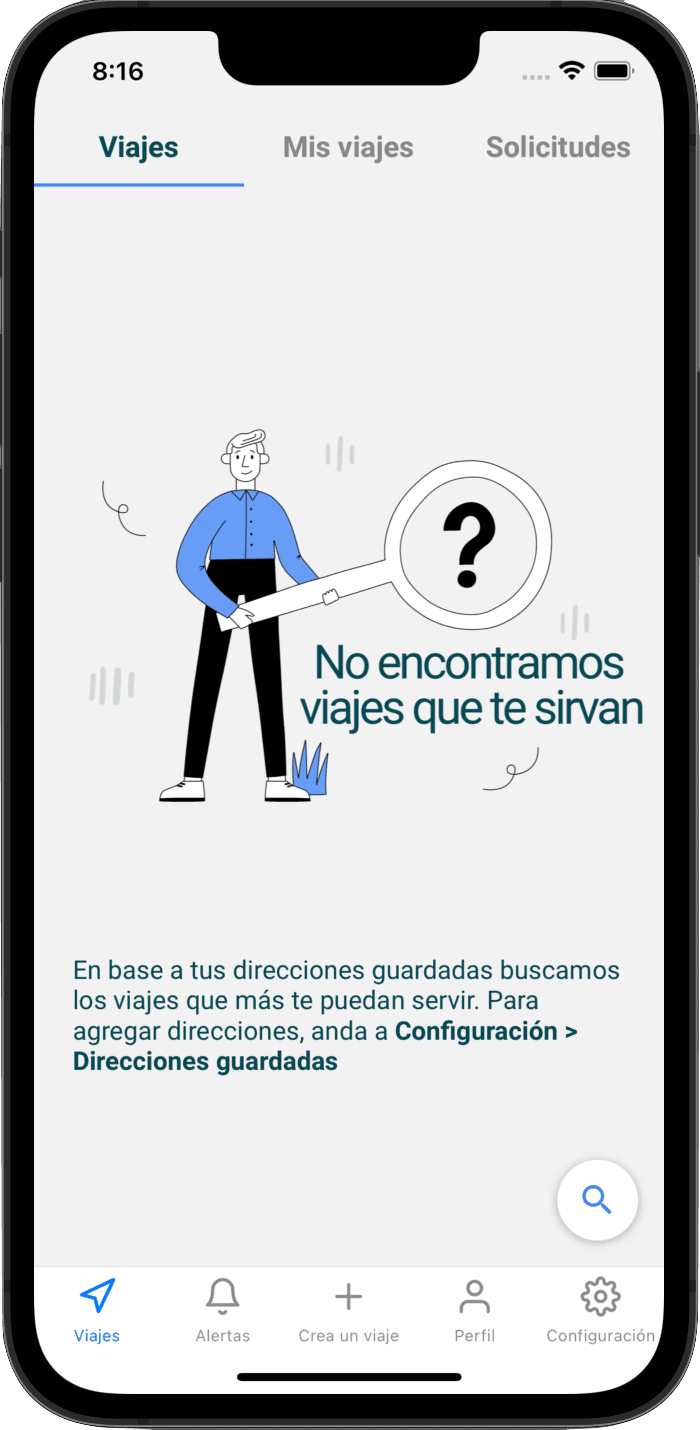
Matching on geography, with searches that outlive the query
Route matching runs as dedicated geo services rather than as database predicates, and a search that finds nothing today is saved — so the user is notified when a matching ride is posted later. It turns an empty result into a pending one.- Dedicated geo and geocoding services behind the API
- Saved ride searches that fire a notification on a later match
- Map-first interface on the client, not a form with two text inputs
- 02
Identity verified once, at the edge
Firebase issues the token, and an API Gateway JWT authorizer validates it before any function runs. No handler hand-rolls token parsing, which is exactly where auth bugs come from when there are thirty of them.- Firebase JWT authorizer configured at the HTTP API layer
- Sign-in with Google and Apple, plus phone-based registration
- Handlers receive an already-authenticated identity
- 03
A serverless API sized per function
The API is a set of independently packaged Lambda functions deployed with the Serverless Framework to São Paulo — the closest AWS region to Uruguay, which matters more than it sounds when the client is on mobile data on a highway.- Each function packaged and optimised individually, so cold starts stay small
- TypeScript end to end, with the entity and repository layers shared
- Deployed to sa-east-1 for Latin American latency
- 04
The full ride lifecycle, including when it goes wrong
Rides, ride requests, passengers, reviews and complaints are each modelled explicitly. The complaint path is not an afterthought bolted on after the first bad trip — it shipped with the product.- Request and accept flow with seat accounting
- Reviews in both directions, driver and passenger
- A complaint path with its own handling, separate from reviews
- 05
Realtime messaging with shared location
Once a ride is agreed, riders and drivers coordinate in-app. Messaging runs on Firestore with push through Firebase Cloud Messaging, so the conversation survives the app being backgrounded — which it always is, because the user is travelling.- Firestore-backed messaging with live location sharing
- Push notifications through Firebase Cloud Messaging
- Crashlytics, Analytics and Remote Config for release safety
- 06
Two client generations
The product shipped first as a React Native app in TypeScript, then was rebuilt in Flutter as the team's needs changed. Both generations ran against the same API — which is the payoff for having drawn that boundary properly in the first place.- v1: React Native, Redux Toolkit, React Navigation, native maps
- v2: Flutter with Riverpod and a GraphQL client
- One API contract across both, no rewrite of the backend
The stack
Mobile
React NativeTypeScriptRedux ToolkitReact NavigationFlutterRiverpod
API
AWS LambdaAPI GatewayServerless FrameworkTypeScript
Data
PostgreSQLFirestore
Identity
Firebase AuthGoogle Sign-InSign in with Apple
Platform
Firebase Cloud MessagingCrashlyticsAnalyticsRemote Config
I couldn't be happier with the outstanding job pdelabs did in developing our carpooling app. Their team was always available, responsive, and really understood what we wanted, the development process was really smooth and we always knew what to expect. I highly recommend them for any software development needs.
- Mario Guadalupe, founder
- Mario Guadalupe, founder
Have something like this to build?
Schedule a call now
Or
if you prefer taking it offline, write us
via email
if you prefer taking it offline, write us
via email